Some songs are carried lightly. They rise from joy, gratitude, or the simple pleasure of being alive.
Others are carried with trembling.
Habakkuk’s song belongs to the second kind. It does not emerge from a world that has suddenly become safe or understandable. The prophet has looked directly at violence, injustice, and the apparent silence of God. He has asked difficult questions and received answers that do not make the road ahead easier.
Yet by the end of his book, Habakkuk sings.
That movement—from questioning to worship—does not mean his fear has disappeared. The circumstances have not been neatly resolved. The fields may still fail. The flocks may vanish. The future may remain uncertain.
The song rises anyway.
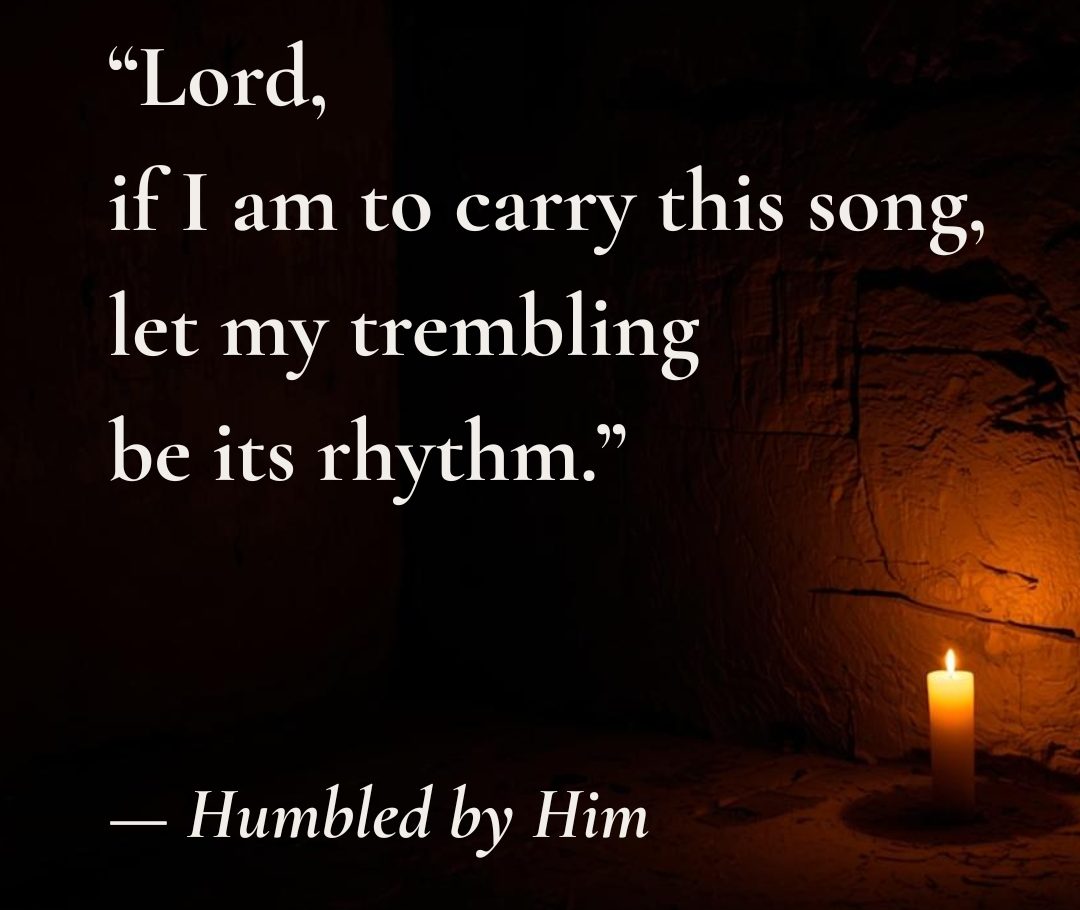
That is the meaning behind the line: “If I am to carry this song, let my trembling be its rhythm.”
The trembling is not an interruption of faith. It becomes part of the offering.
We sometimes imagine that we must overcome every fear before we can speak faithfully, create honestly, or obey courageously. We wait to feel certain. We wait to become strong. We wait for our hands to stop shaking.
But perhaps God does not always ask us to stop trembling.
Perhaps He asks us to carry the song while we tremble.
To carry a song is not the same as owning it. The messenger does not create the truth he bears. He receives it, lives beneath its weight, and passes it on as faithfully as he can. Habakkuk’s burden was not merely a message to deliver. It was something he had to inhabit.
His questions became part of his prayer.
His waiting became part of his worship.
His fear became part of the rhythm.
There is humility in that kind of faith. It does not pretend to understand everything. It does not manufacture confidence for appearance’s sake. It simply says: I am afraid, Lord—but I am still listening. I am still here. I will still sing.
That is the heart of Humbled by Him.
The prophet’s strength is not found in becoming untouched by grief or uncertainty. It is found in allowing himself to be changed by the God he encounters. His song is powerful precisely because it has passed through lament, waiting, and awe.
Faith is not always a steady voice.
Sometimes it is a trembling voice that refuses to become silent.
And sometimes the trembling itself becomes the rhythm by which the song is remembered.
Leave a Reply